
DZ was 39 years old when he was violently assaulted and suffered an acquired brain injury. After emerging from a PDoC state, DZ was only able to communicate using non-verbal means, much to his and his family’s distress. He was admitted to The Bridge Neurological Care Centre for a multidisciplinary assessment and rehabilitation. Here’s the story of DZ’s extraordinary neurorehabilitation journey to rediscover his voice.
DZ’s story
DZ (aged 39 years old) was admitted to The Bridge Neurological Care Centre in August 2022 for a multidisciplinary assessment and rehabilitation. He had recently emerged from PDoC state (Prolonged Disorder of Consciousness) following a severe acquired brain injury from an assault.
On admission, DZ was unable to speak or vocalise and demonstrated cognitive difficulties. He communicated using non-verbal means, principally by blinking or occasionally using a thumbs up. DZ had very restricted head movements making nodding/ shaking his head a non-reliable means of communication.
Speech and Language Rehabilitation Programme
Following a thorough assessment of DZ’s communication skills, including oral and written language, the Speech and Language team at The Bridge created a comprehensive rehabilitation program to enable him to improve his functional communication. AAC (Augmentative and Alternative Communication) means were thoroughly explored to install a reliable, consistent and less effortful means of communication.
Augmentative and Alternative Communication (AAC) is a range of strategies and tools to help people who struggle with speech. AAC helps someone to communicate as effectively as possible, in as many situations as possible. Communication boards including Yes/No coloured cards and picture boards with written language were also introduced.
DZ was able to consistently and reliably communicate his needs and answers using his left hand to point at the relevant photos/ cards. Yes/ No buzzers were also explored but DZ preferred using his paper-based cards to convey his responses.
Mira Bou Akar, Lead Speech and Language Therapist at The Bridge Care Centre, worked with The Bridge team members to raise awareness of AAC implementation and encourage its use in day-to-day activities.
Mira says: “Liaising with the nursing and therapy team, the staff on wards and everybody working with DZ is key to help implement what he has gained from speech therapy sessions into his daily activities. I would update the team on how best to communicate with DZ, depending on what stage in therapy he was at. We would discuss DZ’s communication and cognitive needs and go through when and how to implement adequate adaptations.
“For example, when we first received DZ’s high-tech AAC device, I would show the ward staff how to use it, we would encourage him to communicate his needs during physiotherapy sessions or on the ward, etc. This has promoted further independence and his active involvement in his care.”
Regional Communication Aids Services (RCAS)
Following regular discussions with DZ and trials of computer-based grids, a referral to the Regional Communication Aids Services (RCAS) was also arranged. SALT liaised closely with RCAS team to ensure that the AAC device provided suited DZ’s individual needs according to his SALT assessments results.
DZ was happy to communicate using a computer-based high tech AAC until he regained his speech back, however, his ultimate goal was to be able to speak again. DZ’s family, who were unable to visit regularly, were also struggling to communicate with their son via video call.
Mira Bou Akar, Lead Speech and Language Therapist, explains how the separation between the family and DZ affected their respective wellbeing and how it spurred DZ on in his rehab programme.
Mira says: “I remember when DZ was regaining his verbal communication, I’ve asked him how he felt about his last phone call he had with his family and he responded ‘’Happy’’, which nicely described the impact his speech impairment had on his wellbeing and motivation.”
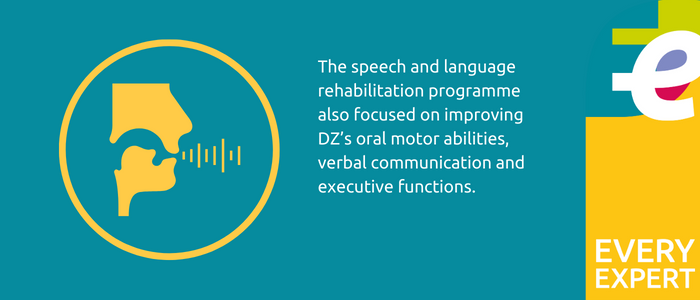
The program also focused on improving DZ’s oral motor abilities, verbal communication and executive functions. Executive functions (EFs) include high-order cognitive abilities such as working memory, inhibitory control, cognitive flexibility, planning, reasoning, and problem solving (Irene Cristofori, 2019). These could restrict communication abilities (L. Spitzer el al., 2020). Varied exercises trained the muscles involved in speech to improve their strength and range of movements alongside executive functions skills as DZ had difficulties planning and purposefully initiating vocal productions.
Demutisation techniques
Intensive speech and language therapy sessions were conducted to work on DZ’s mutism. DZ could not vocalise purposefully, restricting his abilities to regain his verbal communication. Vocal productions were solely limited to when he coughed or following a yawn.
Mira Bou Akar, Lead Speech and Language Therapist, began implementing demutisation techniques and speech initiation following cough and yawn episodes.
Mira explains: “To begin with, it was very challenging to get DZ to initiate any vocal production on prompts especially with his initiation and planning difficulties. Coughing and yawning are automatic and were the only occasions DZ would spontaneously produce a voice. I used auditory, physical, kinaesthetic and proprioceptive supports by inviting DZ to “hear” his voice and “feel” the vibration of his vocal cords and progressively maintaining a vocal production following coughing or yawning.
“Afterwards, I introduced counting tasks as this is also an automatic speech. Whenever DZ struggles to initiate a voice we would start by counting with or without MIT which worked well for him. These prompts and supports were progressively withdrawn with DZ successfully achieving vocalisation spontaneously.”
Melodic Intonation Therapy (MIT)
Melodic Intonation Therapy (MIT) was implemented, alongside working with automatic language. With lots of training, DZ started maintaining his vocal productions for longer and initiating them on instruction. Physical, visual and verbal cues were given during vocalisation, DZ was prompted to ‘’feel’’ vocal cords vibration with varied feed-backs guiding his productions. During initial stages, word repetition, naming tasks and spontaneous speech were challenging and effortful. DZ needed lots of prompts via automatic language and MIT to initiate his speech and complete these tasks.
Following intensive speech and language therapy intervention, DZ’s speech initiation had largely improved, requiring minimal to no prompts. Speech rehabilitation targeted at this stage progressively increasing sentence length, complexity and speech intelligibility. Functional communication was targeted to enable DZ to communicate his needs and interact in daily conversation with staff and family members. SALT, nursing and therapy team members worked together to establish communication recommendations and encourage DZ’s verbal communication in varied contexts.
LSVT Loud
With DZ’s improved sentence length and speech abilities, LSVT Loud suitability is being explored to further improve his vocal loudness. LSVT LOUD is said to improve communication by helping you speak with a voice and volume that’s easy for others to hear and understand. The treatment is built on tailored exercises that strengthen the voice box (larynx) and speech system.
Regaining his voice
In April 2023, DZ achieved his goal to speak again. He was able to communicate his needs verbally using short sentences spontaneously and longer sentences with encouragement. He was able to read paragraphs out loud with occasional visual errors. Successfully video calling his family was also achieved with DZ’s mum reporting “I had tears in my eyes when I first heard his voice”.
Mira Bou Akar, Lead Speech and Language Therapist, shares how she feels about DZ’s success.
Mira says: “It was a pleasure working with DZ – speech and language therapy is one of the most rewarding professions because seeing the impact our therapy has on patients’ and their families’ life is so fulfilling. And this is certainly true in DZ’s case. However, this was not achieved in isolation, only with a multidisciplinary approach could we achieve these outcomes and improve DZ’s quality of life.
Mira says: “It was a pleasure working with DZ – speech and language therapy is one of the most rewarding professions because seeing the impact our therapy has on patients’ and their families’ life is so fulfilling. And this is certainly true in DZ’s case. However, this was not achieved in isolation, only with a multidisciplinary approach could we achieve these outcomes and improve DZ’s quality of life.
“DZ is still progressing and we are now exploring his abilities to eat and drink orally again, another goal both DZ and myself are so excited to achieve!”
References:
Make An Enquiry
If you’d like to make a referral then please get in touch with us.
You can also visit each service’s profile page to find out more about what our EveryExpert approach to care looks like in practice:
Adderley Green, Staffordshire
Badby Park, Northamptonshire
Garden & Jacobs, Hertfordshire
Moorlands, Staffordshire
St Neots, Cambridgeshire
Stanley House, Herefordshire
The Avalon Centre, Wiltshire
The Bridge, Middlesbrough, Wiltshire
The Dean, Gloucestershire
