

A trio of Elysium Neurological’s Senior Clinicians delivered an overview of neurobehavioural rehabilitation to specialist NHS teams at the Haywood Hospital and Royal Stoke Hospital earlier this month.
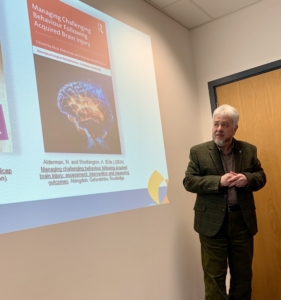
Professor Nick Alderman (Senior Clinical Director, Head of Psychology and Consultant Clinical Neuropsychologist), Paul Mooney (Clinical Director – Development & Improvement, Consultant Forensic Psychologist), and Fiona Box (Executive Hospital Director) presented to members of the Multidisciplinary Team (MDT) at the Haywood Hospital in Stoke-on-Trent, and were joined by staff from the trauma ward at the Royal Stoke Hospital.
Elysium Neurological work closely with the NHS providing specialist neurobehavioural rehabilitation for individuals who have challenging behaviour as a consequence of an acquired brain injury in services across the country.
The presentation provided an overview of the specialist care at these services, and shared valuable insight into the two main ways that neurobehavioural rehabilitation can enable people with acquired brain injury to achieve their full rehabilitation potential. Firstly by providing means to manage challenging behaviour that prevents engagement in therapy, and secondly by maximising social and other opportunities to practice and learn skills introduced in rehabilitation sessions out into the real world.

In addition, clinicians’ knowledge was enhanced through aiding understanding of what drives challenging behaviour following acquired brain injury, and how interventions drawn from learning theory and neuropsychology can provide a solution to reduce these. This was illustrated through a detailed case study of an individual who had been admitted into Moorlands Neurological Centre in Stoke-on-Trent.
Professor Nick Alderman was delighted with the positive response from the participants and is looking forward to future collaborations together.
Nick said: “The event went very well – the audience were attentive and interested throughout, asking lots of questions. The
session introduced a complex subject, and our offer to return and facilitate further sessions was well received.
“We hope to work with the team in future, perhaps providing training in how clinicians can best record information concerning challenging behaviour in order to further assist the excellent work the MDT are already doing.”