Multidisciplinary teams (MDTs), a group of professionals from different clinical disciplines who work together to make decisions about the recommended treatment for patients and provide their care, have been operational within Child and Adolescent Mental Health Services (CAMHS), with varying degrees of success, since the late 1990s (Partridge et al,. 2010).
An effective and well-functioning MDT combines both the professional training of each clinician and their individual interests and expertise to help generate positive outcomes for patients. The richness of each discipline is utilised to its fullest while respecting differences of opinion and facilitating dialogue to ensure that the most appropriate treatment and care for each patient is provided. However, in practice, there can be challenges to achieving successful MDT working, and so an ongoing commitment to the team ethos, recognising the value that other professional disciplines bring, is required by each team member.
In this CAMHS EveryExpert article, we speak with clinicians from across the different CAMHS services at Elysium who share their perspectives on what elements are necessary for an effective MDT in CAMHS and why they’re essential when working towards positive outcomes for young people.
Flexible and adaptable approach
An effective MDT is person-centred and aims to tailor treatment and care to an individual’s specific needs, which often change over time. According to Laura Herdman, Executive Hospital Director at Elysium Healthcare, the evolution of the MDT must take place alongside the young person as they develop, and should always be considerate of the many changes and developmental factors that affect young people in particular.
Laura says: “An MDT must adopt a very flexible approach when working with young people, especially if the young person is receiving treatment as they go through puberty. There’s so much change happening in that young person’s mind and body, and the MDT needs to be considerate of that.
“You always have to think about what’s actually normal for a teenager, versus what might be related to a disorder. So, as a team, we try to recognise that and understand the development of the young person, which means the MDT approach will evolve alongside the young person.
“Co-production is vital – we make sure that the young person is at the centre of everything an MDT does. Nothing is ‘done’ to the young person, instead, everything happens with their agreement and involvement. What makes a really good MDT is that everyone listens to that young person, hears what they are saying and works with that.”
Importance of co-production
Co-production is based on the idea that people with lived experience are best able to advise on what services or care and treatment will help them. Colleen Fahy, Regional CAMHS Quality Manager, shares her thoughts on how MDTs can embrace co-produced ways of working so that young people have a say in the care they receive.
Colleen says: “Fundamentally, the young person has to be involved in the decision-making around their care. Even if they have been sectioned and we have to make decisions for them because they don’t have capacity/competency at that particular time, we still try to engage them at the point they are ready to engage.
“For an MDT in CAMHS to work successfully and achieve positive outcomes, the team members need to reach out to the young person and meet them where they are. We have to adapt the way we work – it’s scary for a young person to sit in a room full of adults, because they often hear things they don’t want to hear.
“If we can’t get the young person to participate in an MDT working group, we’ve got to go to them and talk with them because they will tell you things in the course of normal conversation. Only with the young person’s involvement and engagement can an MDT consider itself to be working effectively.”
A culture of support
Dr. Sophie Nesbitt, Consultant Clinical Psychologist and CAMHS Psychology Lead, explains how it’s important for the team to acknowledge the challenges they face while working within CAMHS to ensure that each team member feels supported and valued.
Sophie says, “There are many important criteria needed for a CAMHS MDT to be able to work together successfully. CAMHS can be a very challenging place to work – we’re providing care at the hardest point of a traumatic journey for the young person and their family.
“One of the most important is a culture of support, so that each and every team member feels adequately equipped and helped to do their job. For example, team members need access to relevant training and to be actively enabled to complete the training. Good supervision frameworks should be in place, and services should operate reflective practice systems for teams to meet and reflect on the challenges of working with young people and their families.
“This culture then helps promote team unity and solidarity, which can combat some of the challenges the team might face.”
Strength in differences
For Dean Swire, Regional Operations Director for Elysium’s CAMHS services, the strength of an MDT comes through valuing differences in perspectives and clinical experience, and prioritising communication, especially the ability to listen.
Dean says, “The whole purpose of an MDT is to see things through different clinical lenses, informed by varied experiences and professional opinions. If we all look through the same lens, we end up with group thinking, and things can get missed. Members of an MDT should be willing to share those differing ideas in a constructive way, but are equally able to challenge perspectives to come to an agreed resolution. Consistency is important, but it can also be beneficial to have input from new team members. We must bear in mind that legislation changes and patient profiles change – the MDT needs to be fluid enough to adapt.
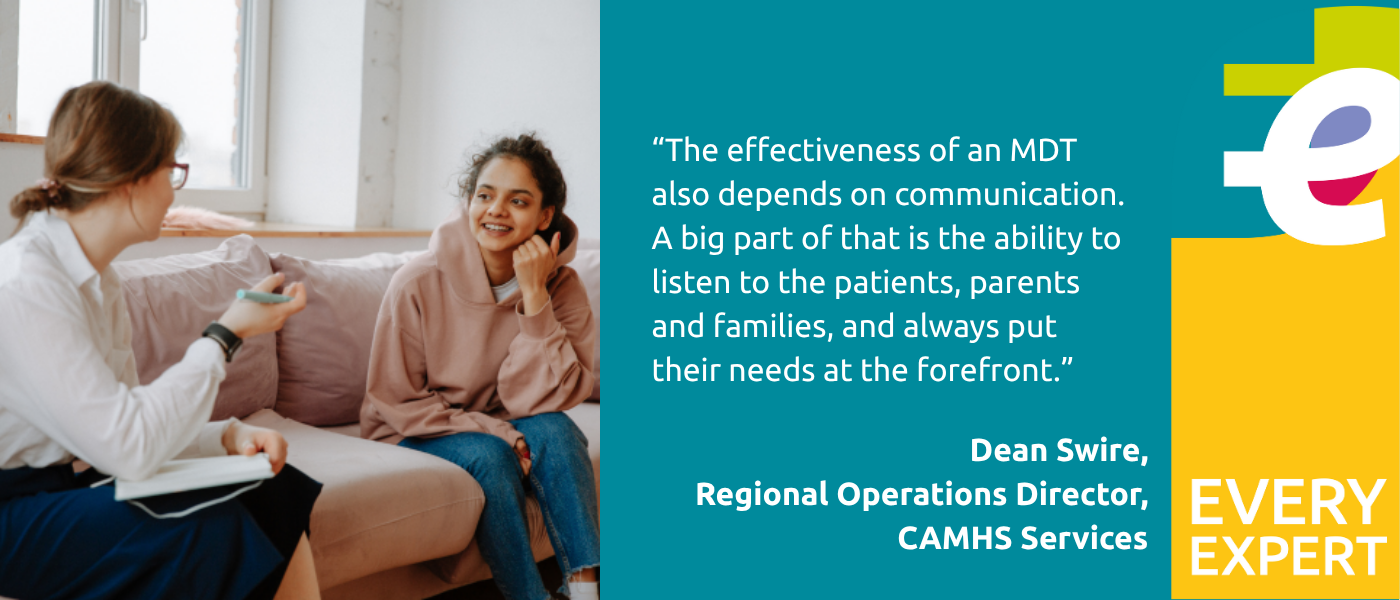
“The effectiveness of an MDT also depends on communication. A big part of that is the ability to listen to the patients, parents and families, and always put their needs at the forefront. An MDT should be transparent in communications, too. It’s important for patient clarity to communicate constructively if there are any concerning or risky behaviours, and also with the positive behaviours, because it is vital for patients to feel hope that they are moving towards the end goal.”
An equal partnership
The MDT model is based upon a culture of equality and support, where the contribution of each team member is valued, but sometimes, in practice, some members of the MDT may be heard less than others. According to Nick Shaughnessy, Regional Director of Nursing – CAMHS, an effective MDT depends on nurses feeling comfortable and confident enough to voice their experiences and insight when appropriate.
Nick says, “In some cases, nurses spend 24 hours a day with patients, so they can bring with them a wealth of knowledge about what an individual is like outside of therapeutic sessions. They can also feed back how individual patients are implementing strategies that are being discussed in other therapies, and they can support individuals with maintaining those strategies.
“It can be quite easy at times for nurses to take a back seat in MDT discussions and be led by other people, not always valuing what they’re doing on a day-to-day basis and the information that they have. Part of my work at Elysium is working with the nurses to feel more confident speaking up in meetings and knowing that their views and experience are valuable to the wider MDT.”
References
Partridge, I., Richardson, G., Casswell, G., & Jones, N. (2010). Multidisciplinary working. In G. Richardson, I. Partridge, & J. Barrett (Eds.), Child and Adolescent Mental Health Services: An Operational Handbook (pp. 69–77). Chapter, Cambridge: Royal College of Psychiatrists.