

In May 2024, Gillian ‘Gill’ Haines was found unresponsive in bed by her daughter and quickly taken to Luton and Dunstable Hospital for emergency treatment. The medical team soon established she’d had a stroke, and a bleed within the left side of the brain, which had left Gill with debilitating physical symptoms and impacted her ability to communicate.
A month later, Gill was discharged into respite care before the team at Avonfield Neurological Care came to assess her. Lead Nurse and Deputy Care Centre Director, Gemma Sisman, explains how the service worked to empower Gill to communicate again.
Gemma said: “When I first went to assess Gill, it was immediately clear that her challenges with communicating her needs were taking a significant emotional toll on her. Gill was frequently tearful as she tried to articulate what she wanted to say but wasn’t able to communicate what she was thinking and feeling.”
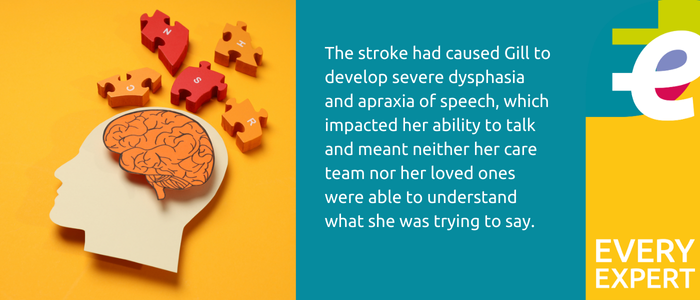
The stroke had caused Gill to develop severe dysphasia and apraxia of speech, which impacted her ability to talk and meant neither her care team nor her loved ones were able to understand what she was trying to say. In some instances, patients can revert to writing things down to make themselves understood, but the stroke had impacted the right side of her body, and being right-handed, Gill wasn’t able to rely on this either.
Finding solutions to communication barriers
Gill left her respite care home and arrived at Avonfield, where the neuropsychology team conducted their assessment of her needs. They identified Gill’s frustration with the difficulty she was having communicating with others as the most significant obstacle she was facing. She was demoralised and isolated, which often resulted in tearfulness.
Gemma said: “Rather than completing traditional cognitive assessments, due to the difficulty in communication, we did a lot of work with her mood and wellbeing instead. Through that work, which often involved singing and other activities, we could identify that Gill appeared to have a good cognitive function level, and her long-term memory was intact.”
The team at Avonfield started working with AAC to develop new ways for Gill to communicate.
Gemma explains: “It was important when using AAC tools to keep the questions very simple and provide visual aids to prompt a response. Gill was able to give a ‘yes’ or ‘no’ response to a picture or on a page, and point to pictures of what she wanted. Although levels of tiredness or a low mood could impact this. We’d also find there were times when Gill lacked insight into her communication difficulties and would attempt to speak and be perplexed as to why we couldn’t understand her. At those times, the care team would step in and use the AAC tools to prompt her.”

Improving the personal care experience
The MDT at Avonfield were also working on Gill’s nursing needs to support her with food and fluid intake. Given the challenges she faced, they decided to introduce supplements four times a day to boost her nutrition, as well as monitor her food and fluid intake.
Gemma said: “Gill was on a level 6 soft and bite-sized diet but could take fluids normally. She could also sometimes eat independently with a plate guard, but it would depend on how fatigued she was feeling. If she felt very tired, Gill would need full support to eat.”
The Occupational Therapy team worked with Gill to enable independence and used a tilt-in-space wheelchair, which meant Gill could transfer with two people’s support to a tilt-in-space shower chair, so she no longer needed bed baths. The team also completed a wheelchair assessment to begin the process of getting Gill her own wheelchair. Gill also received regular sessions with the Speech and Language Therapist working on her speech, and during her time at Avonfield she began being able to say short phrases and greetings to communicate to her family.

Approaches to further boost wellbeing
It was clear Gill was a very social person who valued being with others so not being able to communicate had a significant impact on her mood. Thanks to the use of AAC tools for communication, there was an ongoing improvement in Gill’s mood. She participated in group activities, particularly enjoying the musical groups and visits from musicians.
One-on-one pampering sessions also had a positive impact on Gill’s mood, and she enjoyed spending time listening to the radio. Her care team also wanted to help Gill access the community.
Gemma added: “One trip to the local supermarket café was so successful that Gill didn’t want to leave because she enjoyed her hot chocolate and brownie so much. She also laughed at men walking past wearing shorts on a cold day – it was good to see how much Gill enjoyed being out and using the minibus.”
A deeply emotional connection
While at Avonfield, Gill built an incredibly warm and positive relationship with the care team.
Gemma explained: “All our staff used to refer to Gill as ‘Grandma’ and she loved that. If you were to see Gill or talk to her, you’d understand why immediately. She is the loveliest lady and very easy to engage with, even though she can’t communicate verbally. Gill has a very expressive face and uses her expressions to convey her feelings. It was wonderful to see her giggle. She would have tears, but they were sometimes happy tears, which was very touching. Everyone here was very sad when she was discharged as she is much-loved at Avonfield.”
The strength of the bond between Gill and those caring for her at Avonfield was highlighted by her family. Gill’s daughter Jenny and son-in-law Michael spoke highly of her experience at the service when she was discharged.
Michael, writing on behalf of Gill, said: “The welcome and ongoing support was amazing. Gill’s care was first class – all our concerns and questions [were] quickly answered, and none [were] dismissed. The accommodation, food and staff support are all first class. [It was] so great to have all rehab support so readily available.”
Make An Enquiry
If you’d like to make a referral then please get in touch with us.
You can also visit each service’s profile page to find out more about what our EveryExpert approach to care looks like in practice:
Adderley Green, Staffordshire
Badby Park, Northamptonshire
Garden & Jacobs, Hertfordshire
Moorlands, Staffordshire
St Neots, Cambridgeshire
Stanley House, Herefordshire
The Avalon Centre, Wiltshire
The Bridge, Middlesbrough, Wiltshire
The Dean, Gloucestershire