

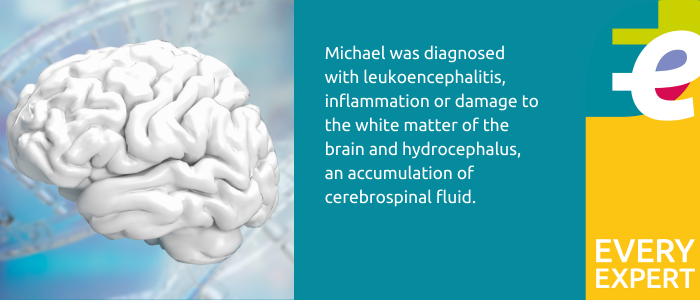
In late Summer 2024, 40-yr-old Michael was discharged from Luton and Dunstable Hospital to the Archer Unit with a diagnosis of leukoencephalitis, inflammation or damage to the white matter of the brain and hydrocephalus, an accumulation of cerebrospinal fluid. These conditions impacted the left side of Michael’s body, reducing his ability to balance on his left leg, rendering him unable to walk or move independently.
It was hoped that a rehabilitation programme at the Archer Unit could help restore some of Michael’s mobility, however his cognition began to worsen so in October of that year he was assessed by the team at Avonfield Neurological Centre, in Northamptonshire, for more specialist rehabilitation. In this EveryExpert case study, we explore how the therapy team at Avonfield worked with Michael to help him regain his balance and start walking independently again.
Assessment and goal setting
Emily Irvin, Clinical Lead at Avonfield and Marlon Shepard, Occupational Therapist, conducted the assessment and recommended a six-week rehabilitation programme to work on his mobility goals. Marlon explains Michael’s main goals at this point.
Marlon says: “When we met with Michael to discuss his rehabilitation, his main goal was to be able to walk again. He was frustrated by the mobility challenges he was experiencing and wanted to be able to do more things independently. Michael lives in a first floor flat that didn’t have lift access, so it was imperative that our rehabilitation programme was designed to meet his needs and ensure that he could be safely discharged to his home.”
A determined start
When Michael arrived at Avonfield to begin rehabilitation, he was mobilising with a gutter frame with assistance of one staff member. Previously, Michael had been using methadone to withdraw from drugs, but by the time he started rehabilitation, he hadn’t used methadone, drugs or alcohol for three months and was committed to his sobriety. Lead Nurse and Deputy Care Director, Gemma Sisman, explains how Michael’s determination to stay clean and work hard on rehabilitation was evident from the start.
Gemma explains: “Michael was highly motivated and approached his rehabilitation programme with a great deal of positivity. He didn’t feel that he needed support with his sobriety as he was certain that he didn’t want to use drugs or alcohol anymore. Instead, Michael was absolutely determined to walk again, to work on his independence and to get out and about in the local community.”
Building back strength
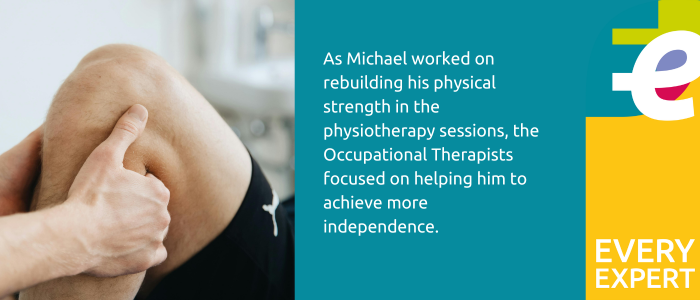
The physiotherapy team started working with Michael at bi-weekly sessions doing a range of strengthening exercises. Outside of these structured sessions, Michael was given exercises to complete independently and others that his care team could support with.
Gemma explains: “Michael’s physio sessions involved various strength and stretching exercises for his left leg to build up his hamstring and quadriceps. He also completed gait training with and without his elbow crutches, as well as dynamic and static balance exercises.
“It was important to get his left knee joint mobilising and build up his ability to shift weight onto his left leg. His physio did a lot of work on stairs with him to prepare him for living back at his flat. Michael also used the exercise bike frequently to build strength and could go on it with the help of carers, so he could embed the exercises into his daily activities in addition to his physiotherapy time.”
Preparing for an independent future
As Michael worked on rebuilding his physical strength in the physio sessions, the Occupational Therapists (OTs) focused on helping him to achieve more independence. On admission, Michael needed support with the majority of his personal care and daily living activities. Marlon Shepard describes how significant progress was made during his six weeks of rehabilitation.
Marlon says: “The OT team worked with Michael on washing, drying, dressing, personal care and using the toilet. By the time he was discharged, he could do all of those tasks without aids and completely independently. We also concentrated on food preparation and kitchen skills to help Michael learn to make meals himself and navigate the kitchen without aids.
“To support his independence, we also worked with him on food shopping, which included activities such as making and implementing a shopping list, managing money and going to the shop to purchase everything on the list. Michael also looked at online food shopping and how that could work for him and his lifestyle.”
A remarkable rehabilitation
Following his six weeks of rehabilitation at Avonfield, Michael had made excellent progress. As the team got ready to discharge him, they completed the Functional Independence Measure (FIM) and Functional Assessment Measure (FAM) to assess how far he’d come. Gemma explains Michael’s impressive progress.
Gemma shares: “The progress Michael made during his time with us was significant. He arrived using a gutter frame to mobilise and, by discharge, was able to walk independently using a single elbow crutch and perform all his transfers without support. There were considerable gains in his muscle strength, balance, gait training and functional independence. He was even able to perform a squat independently without resistance, which shows how far he’s come.
“On the FIM-FAM scale, he went from a score of 27 out of 49 for mobility on admission to 45 out of 49 on discharge, which is remarkable progress. For self-care, he was assessed to be 49 out of 49 on the FIM-FAM when he left Avonfield. These are great outcomes for Michael and the team who worked with him.
“Michael has retained his positivity and determination throughout his time with us, and we’ve set goals for him which he’ll work on with his community teams. With continued support and rehabilitation sessions, we’re confident that Michael can build on the improvements he’s made here and achieve more of the goals he’s set for himself.”
Make An Enquiry
If you’d like to make a referral then please get in touch with us.
You can also visit each service’s profile page to find out more about what our EveryExpert approach to care looks like in practice:
Adderley Green, Staffordshire
Badby Park, Northamptonshire
Garden & Jacobs, Hertfordshire
Moorlands, Staffordshire
St Neots, Cambridgeshire
Stanley House, Herefordshire
The Avalon Centre, Wiltshire
The Bridge, Middlesbrough, Wiltshire
The Dean, Gloucestershire
