
In 2015, JC was hit by a car and sustained life-changing injuries after suffering a brain haemorrhage caused by the accident. In addition to her brain injury, JC was diagnosed with dysphagia and a cognitive communication disorder, as well as hearing loss and reduced mobility which requires her to use a wheelchair.
After two challenging years receiving treatment at other neurorehabilitation services, JC arrived at Badby Park, part of Elysium Neurological, in 2017, displaying aggressive behaviours and needing 24/7 support. But seven years later, after completing an intensive rehabilitation programme with the specialist Multidisciplinary Team (MDT), JC is looking to a brighter future with increased independence. This is the story of JC’s inspiring rehabilitation progress and the power of personalised communication support.
JC’s story
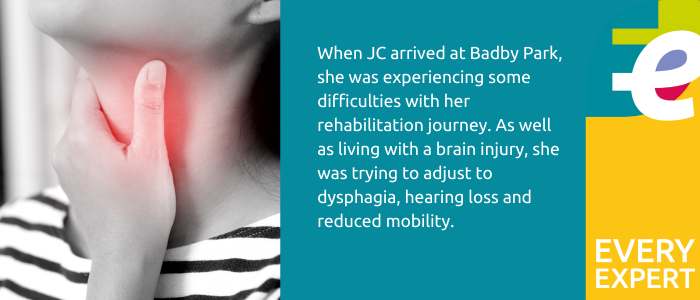
When JC arrived at Badby Park, she was experiencing some difficulties with her rehabilitation journey. As well as living with a brain injury, she was trying to adjust to dysphagia, hearing loss and reduced mobility. As a result, JC’s frustration was manifesting in behaviour that could be seen as challenging (physical and verbal). Wiktoria Blaszczak, Occupational Therapy Assistant, began working with JC soon after she arrived, and recalls the early days of her rehabilitation programme.
Wiktoria says: “At first, JC displayed a range of behavioural responses that were adversarial and not helping her to make progress, and she needed support with Activities of Daily Living (ADL) and transfers. When I began working with her, she was receiving one-to-one support 24/7 and a lot of her behaviours were related to food.
“JC has dysphagia, which makes it difficult for her to swallow because her tongue shows signs of fatigue when she’s eating. This can lead to risk of choking or aspiration, so JC needs to stop eating after 30 minutes, and we also need to practice portion control during that time. At first, JC didn’t like having to stop eating but at that point she didn’t understand why she had to.”
It transpired that a crucial part of the rehabilitation for JC was helping her understand that she had a brain injury and how that was impacting her life. Shraddha Dedhia, Assistant Psychologist at Badby Park explains how the psychology and wider MDT team worked with JC to help improve her understanding through personalised communication support.
Shraddha explains: “Due to the nature of her brain injury, JC didn’t understand that she had a brain injury and, therefore, why specific interventions were in place to support her and protect her from risk. The psychology team worked closely with her to help her gain cognisance of the situation and to give her more information about her condition. By establishing this improved communication and understanding with JC, the psychology team were able to help her understand what was happening and why.”
The MDT – including Psychologists, Occupational Therapists, Speech and Language Therapists and Physiotherapists – also used Positive Behaviour Support (PBS) with JC, cultivating a sense of inclusion and helping her build the skills to deal with challenging emotions and responses.
Shraddha added: “As her insight increased, her behaviours reduced. Another part of that was addressing her hearing needs too. As she has hearing difficulties, it’s essential that we communicate with her in the correct manner – speaking slowly and clearly and using straightforward language. Previously, she might just nod and accept something we said to her, even if she hadn’t understood it or heard it correctly. Now, she’ll ask and we can make sure we explain everything so she knows what is happening and why.”
Managing Dysphagia
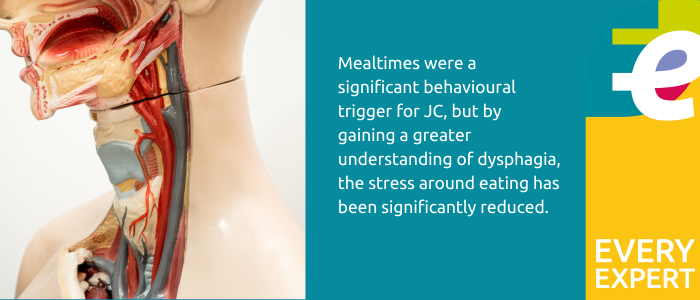
Mealtimes were a significant behavioural trigger for JC, but by gaining a greater understanding of dysphagia, the stress around eating has been significantly reduced. Swallowing requires 26 different muscles to coordinate together to move the food or liquid we consume from the mouth to the stomach. For people living with dysphagia, there’s a disruption between the signals the brain sends to these muscles, so they operate their part in the swallowing process at the right time.
The specialist team at Badby Park have implemented different strategies to help JC consume meals safely. Occupational Therapy Assistant, Wiktoria Blaszczak explains what that involves.
Wiktoria says: “JC is on a modified diet, which means we have changed the consistency of the food and drink she consumes. We support her by ensuring she doesn’t overload her plate, and we are there during the 30 minutes she has to eat. Crucially, we are not restricting her from eating the amount she chooses; she can eat more after a break, but the structure of her mealtimes helps ensure she eats safely.
“Now JC understands why eating needs to pause after 30 minutes and we remind her of this each time she sits down to eat. We let her know the time left after 15 minutes, and when there are five minutes left, we prompt her again. By doing this each time, JC understands the purpose of each intervention.”
Regaining mobility
Part of JC’s rehabilitation was to improve her mobility and restore independence. When she came to Badby Park, she was using a wheelchair and wasn’t able to transfer without support. This was impacting her ability to do daily activities of living, causing distress and frustration.
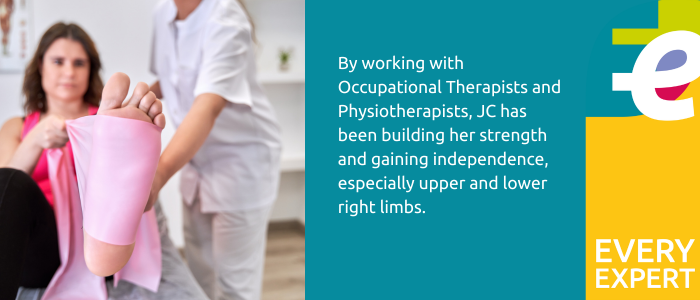
Wiktoria says: “JC does still utilise a wheelchair, and she also uses a quad stick to walk around. But by working with Occupational Therapists and Physiotherapists, JC has been building her strength and gaining independence. Now, she can use the shower and bathroom by herself, she can even do her transfers independently.
“The team have focused on supporting JC to strengthen her upper and lower right limbs because those are her areas of weakness. The physio has also worked on the transfers with JC so she can move around independently.”
Looking to the future
Before the accident JC was a busy mum with two young daughters and family life was disrupted beyond imagination by what happened. The past seven years have presented a myriad of challenges and some setbacks for JC, but as Shraddha explains, understanding and gaining insight into her brain injury was the real catalyst for change.
Shraddha says: “As she’s gained that insight into her brain injury, JC has become more motivated to engage in rehab. Once she understood the problem, she could talk about solutions and work on them. It’s really helped her to move forward. There are minimal challenging behaviours, and she can voice her frustrations in a constructive and polite manner.”
JC’s progress has been inspiring for the whole team and as Wiktoria describes, JC’s determination has never faltered despite experiencing challenges in her personal life.
Wiktoria says: “JC has made incredible progress. It’s amazing to think she was supported 24/7 on a one-to-one basis when she arrived here, and today, she’s planning a more independent future.
“We’re now in the position where we are working with commissioners to find JC her own property or supported living service to move into. Even in the past couple of years, JC has had to deal with a lot of things in her personal life that would be tricky for anybody to cope with, let alone somebody also living with a brain injury. But she’s strong and resilient, and whatever is happening, she just carries on. That’s just who JC is.”
Make An Enquiry
If you’d like to make a referral then please get in touch with us.
You can also visit each service’s profile page to find out more about what our EveryExpert approach to care looks like in practice:
Adderley Green, Staffordshire
Badby Park, Northamptonshire
Garden & Jacobs, Hertfordshire
Moorlands, Staffordshire
St Neots, Cambridgeshire
Stanley House, Herefordshire
The Avalon Centre, Wiltshire
The Bridge, Middlesbrough, Wiltshire
The Dean, Gloucestershire
